
Scotland Weather By Month For Tour Planners
Updated November 3, 2026
Scotland's weather swings from 7-hour December days to 18-hour June ones, and the month you pick changes what a tour feels like more than almost any other decision. Here is the month-by-month picture, with real figures.
Short answer
Edinburgh's average highs run from 7°C in January to 19°C in July and August, with monthly rainfall between 40mm and 73mm across the year. Daylight stretches from roughly 7 hours in December to 18 hours in June. May, June and September offer the best balance of weather, daylight and thinner crowds.
Scotland's weather is not one climate but several: the east coast around Edinburgh is noticeably drier than the west coast and Skye, and daylight varies by more than ten hours between midwinter and midsummer. That spread matters for tour planning. A 12-hour Highlands day tour feels completely different with 17 hours of light than with 9.
The month-by-month figures below are approximate Edinburgh normals for temperature and rainfall, with mid-month daylight hours that apply broadly to Edinburgh and Inverness. The west is wetter, the hills are colder, and no table promises what any single week will do.
What Is Scotland's Weather Like Month By Month?
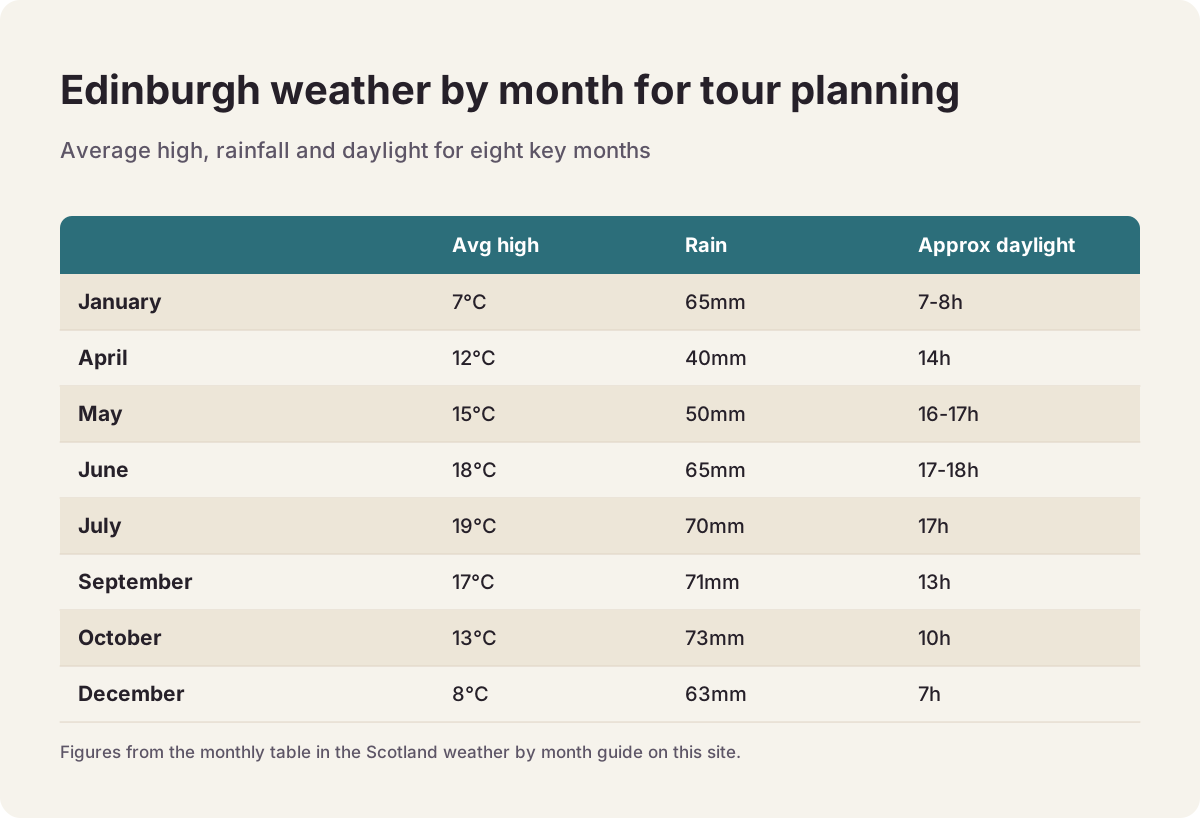
Monthly average highs in Edinburgh run from 7°C in January to 19°C in July and August, with rainfall between 40mm in April and 73mm in October. Daylight climbs from roughly 7 hours in December to 17 to 18 hours in June, the single biggest variable a tour planner faces. Rain is spread across the year rather than concentrated in one wet season, which is why waterproof layers appear on every packing list in every month.
| Month | Avg high (Edinburgh) | Rain (Edinburgh) | Approx daylight | Planner's note |
|---|---|---|---|---|
| January | 7°C | 65mm | 7-8h | Short days limit long day tours |
| February | 8°C | 55mm | 9-10h | Light returning, still cold |
| March | 9°C | 50mm | 12h | Quiet, good value |
| April | 12°C | 40mm | 14h | Driest month on these normals |
| May | 15°C | 50mm | 16-17h | Prime shoulder month |
| June | 18°C | 65mm | 17-18h | Longest days |
| July | 19°C | 70mm | 17h | Peak season, midges peak |
| August | 19°C | 65mm | 15h | Fringe crowds in Edinburgh |
| September | 17°C | 71mm | 13h | Second shoulder window |
| October | 13°C | 73mm | 10h | Wettest month, autumn colour |
| November | 10°C | 69mm | 8h | Cheap, short days |
| December | 8°C | 63mm | 7h | Shortest days, Hogmanay |
Read the table as planning ranges, not forecasts. These are reported averages, and Scotland can produce four seasons in one afternoon anywhere on the map. What the numbers do show clearly is the shape of the year: a dry, brightening spring, a mild but busier summer, a wet autumn, and a winter defined by darkness more than cold.
Which Months Have The Best Weather For A Tour?
May, June and September are the months that consistently balance weather, daylight and crowds, with May offering around 16 to 17 hours of daylight, average highs near 15°C and midge activity still low. June adds the longest days of the year at 17 to 18 hours of light, while September brings 13 hours of daylight and 17°C averages once the school holidays end. None of that guarantees sunshine, but it tilts the odds firmly in your favour.
Travellers ask this constantly on Reddit. A recurring thread in r/travel on the best time to visit Scotland keeps landing on May as the sweet spot: decent weather, before the midge peak, and before the July and August crowd surge. Operators see the same pattern in their calendars, which is why shoulder departures sell early even though peak prices sit in July and August.
For a fuller verdict on the trade-offs, including why May beats September for some itineraries and loses for others, see What Is The Best Month To Go To Scotland?. If budget leads the decision instead, the cheapest month breakdown explains why November through March, outside Hogmanay, is the low-price window.
Multi-day itineraries feel the weather more than city tours, because they commit you to several days of itinerant travel. The 5-day ultimate highland adventure from MacBackpackers runs from $509 per person and is rated 4.9 across 1,026 reviews, and a May or September departure gets you the same route with fewer coaches at the viewpoint car parks. In June, the long evenings genuinely change the day: a tour that finishes near Inverness at 9pm still has light for photographs.
When Should You Avoid Visiting Scotland?
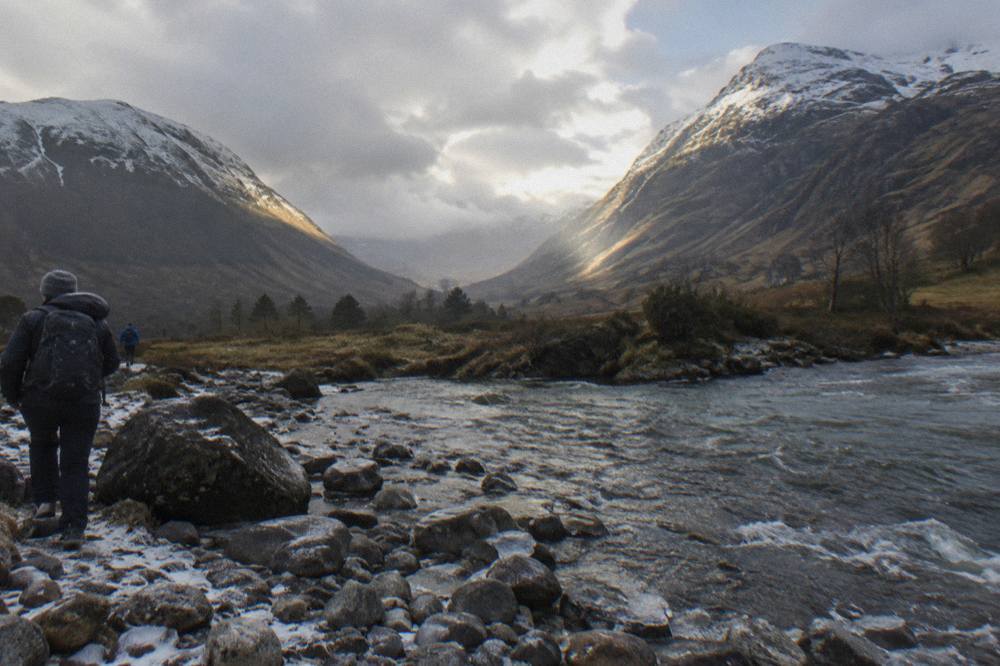
November through January brings 7 to 8 hours of daylight and some seasonal closures, while July and August stack peak crowds, peak prices and the midge peak into the same two months. Both windows have real upsides, cheaper rooms in winter and the warmest temperatures in summer, but they are the two periods travel writers single out as the hardest for road trips and outdoor touring.
One source on timing trips puts it plainly: November to January for short days and closures, July to August for crowds, prices and midges. The closures matter more than the cold: some island ferries move to winter timetables, and smaller attractions shut entirely after October. That is the real constraint on a winter loop, not the temperature.
Winter is not a write-off. Edinburgh's Hogmanay runs 29 December 2026 to 1 January 2027, and the city is at its most alive precisely when the days are shortest. But a Highlands day tour in December means boarding in the dark and watching daylight disappear by mid-afternoon, so short city-based itineraries beat ambitious loops. The detailed month-by-month case, including the midge calendar, is in When To Avoid Visiting Scotland?.
How Do Midges Fit Into The Weather Calendar?
Midge season in the Highlands and Skye runs roughly from late April or early May to the first frost, peaking from June to August and at its worst on the west coast in calm, humid conditions. That overlaps almost exactly with peak tour season, which is the single strongest argument for a May or September departure if your itinerary includes Skye or the west. Height above about 500 metres, wind, the east coast and October onwards are the reliable escapes.
The overlap is not a reason to skip summer, but it is a reason to pack repellent and to know that the problem is worst at dawn and dusk near standing water. A longer treatment of the calendar and the avoidance tactics that actually work, including why a breeze is your friend, is in the Skye midges and best time guide.
Weather advice should not float free of bookings, either. The seasonal breakdown on WeRoad's planning piece reaches the same May, June, September conclusion, and the month tables published by Juniper Tours back the daylight figures above.
How Should The Weather Shape Your Tour Choice?
Let the season dictate your tour length. From May to September, long daylight favours 6-hour-plus day tours and multi-day loops; from November to February, stick to short city tours and castle interiors, since a 12-hour Skye tour from Inverness in midwinter would spend most of the journey in darkness, while the same tour in June gives light until late evening at every stop. Seasonal timetables, ferries and train services tighten the window further.
| Tour type | Best months | Why |
|---|---|---|
| City walking and castle tours | Year round | Weather-tolerant, indoor options |
| Highlands and Loch Ness day tours | May to September | Daylight covers the drive times |
| Skye and island itineraries | May, June, September | Midge pressure lower than July and August |
| Whisky distillery touring | October to March | Indoor by nature, low-season value |
| Jacobite steam train add-ons | June to October | Season runs 1 June to 23 October |
The Jacobite steam train's season dates come from the operator's published 2026 timetable, and they illustrate the point: some experiences simply do not exist outside their weather and light window. The same logic applies to island ferries, where winter timetables are thinner and cancellations more common. For the specifics of a multi-day route, the Isle of Skye tours guide breaks down which itineraries work in which months.
Longer packaged tours give the weather more chances to average out, which is an underappreciated advantage. The 8-day Scottish Dream from CIE Tours, from C$4,245 per person and rated 4.5 across 230 reviews, spreads its stops across a full week, so one wet day in Glencoe does not define the trip. The same logic applies to the 3-day Loch Ness and Skye Magic tour, from $481 per person and rated 4.8 across 341 reviews: two nights on the road means the weather gets three shots at being good. Everything worth knowing about pricing these up is in the Scotland tour package cost guide.
Common Questions About Scotland Weather By Month
What is the warmest month in Scotland?
July and August tie for the warmest in Edinburgh's averages at about 19°C daytime highs. Both are also the busiest and most midge-prone months, which is why May and September often beat them for touring.
What is the wettest month in Scotland?
October, at roughly 73mm of rain in Edinburgh's monthly averages, with November close behind at 69mm. The west coast and Skye record higher totals than Edinburgh across the whole year.
Which month has the most daylight in Scotland?
June, with roughly 17 to 18 hours of daylight in Edinburgh and Inverness. December sits at the other extreme with about 7 hours.
Does it rain all the time in Scotland?
No. Rain is frequent but spread through the year, with monthly averages between about 40mm and 73mm in Edinburgh, and showers often pass quickly. The west is wetter than the east, so a Skye day needs more contingency than a city day.
When is midge season in Scotland?
Roughly late April or early May to the first frost, peaking from June to August and worst on the west coast and Skye in calm, humid conditions. May and September sit at the edges of the season with much lower activity.