Coach Tour or Self-Drive: How to See Scotland
The choice is not really about freedom versus comfort. It is about who absorbs the roads, the ferries and the weather.

Short answer
Drive yourself if you want to stop where you like and you are comfortable on single-track roads with passing places, left-hand traffic and a drink-drive limit stricter than England's. Take a coach tour if you want the ferries, the route and the lodging already solved, or if whisky tastings are part of the plan.
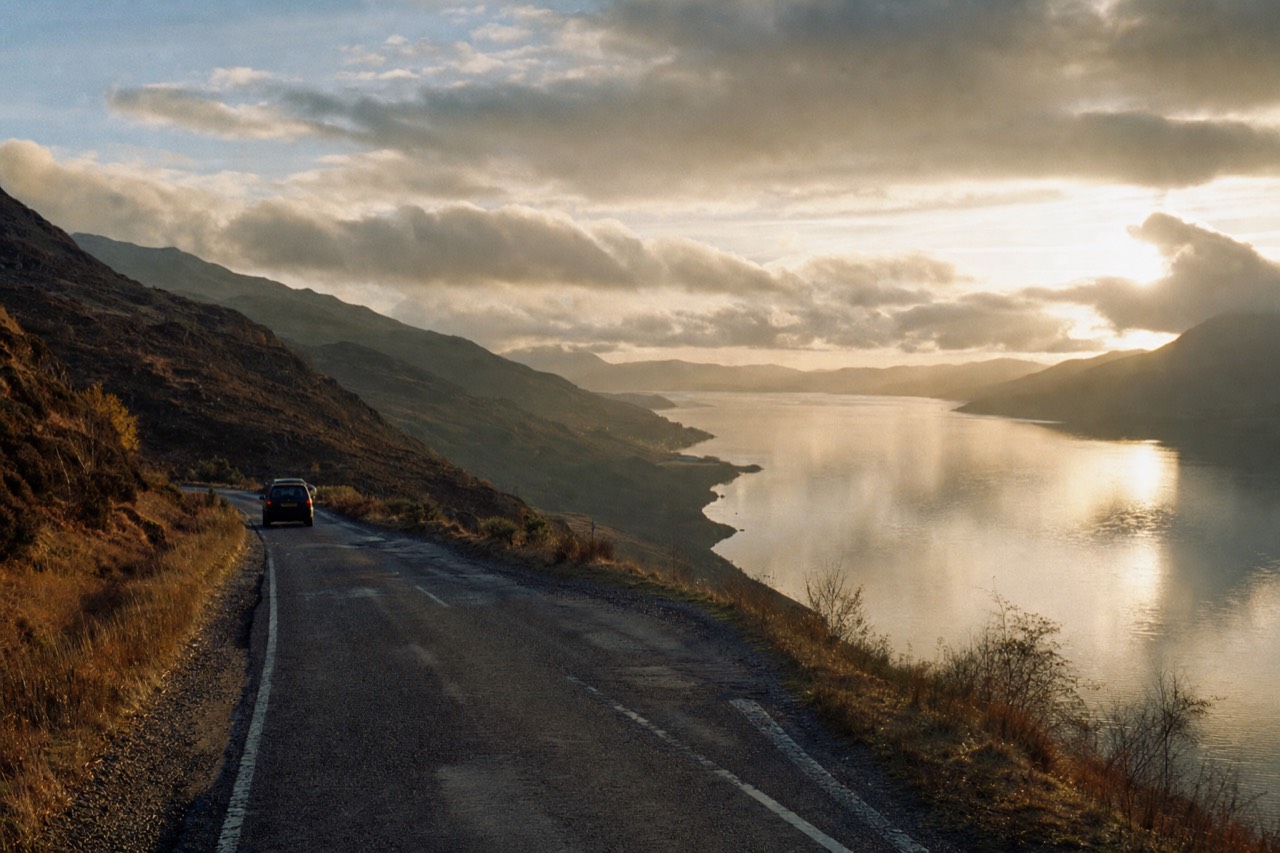
Most of the roads people come to Scotland to drive are single track. Not narrow two-lane roads with a bit of grass at the edges: one lane, with marked passing places at intervals, shared in both directions by locals who use them every day and by visitors who have never met one before. That single fact does more to settle the coach-versus-car question than any comparison of price or comfort, because it decides whether the driving is going to be the best part of your trip or the part you spend the whole holiday dreading.
There is no universally right answer here. There is a right answer for your route, your season, your licence and your tolerance for reversing a hire car sixty metres downhill. What follows is what actually differs between the two, with the road rules and the disruption risks stated properly rather than waved at.
Coach tour or self-drive: what really separates them?
Strip out the marketing on both sides and eleven things genuinely differ.
| Factor | Self-drive | Guided coach tour |
|---|---|---|
| Where you stop | Anywhere, any length of time | Fixed stops, fixed timings |
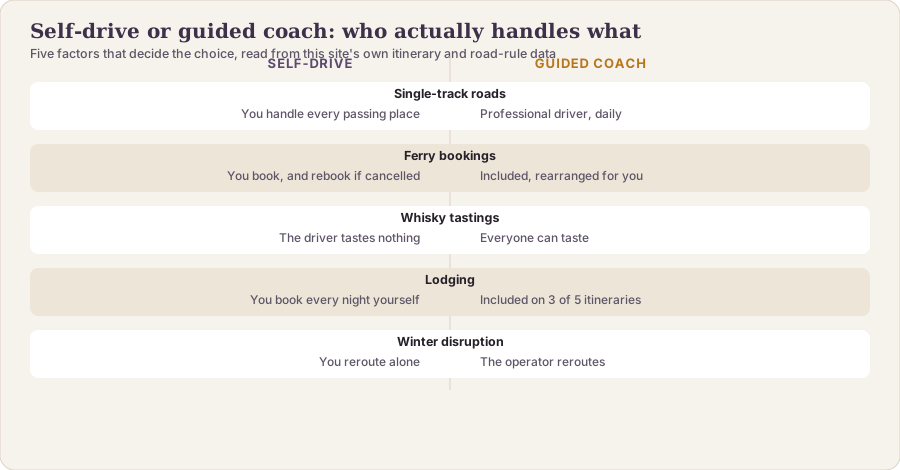
| Single-track roads | You handle every passing place | Professional driver, daily |
| Ferry bookings | You book, you rebook when cancelled | Included and rearranged for you on the packages that carry them |
| Alcohol | The driver drinks nothing | Everyone can taste |
| Lodging | You book each night | Included on three of the five itineraries here |
| Route planning | Yours entirely | Already built and tested |
| Cost predictability | Rental, fuel, parking and beds all float | One fare, with named exclusions |
| Commentary | Whatever you read yourself | Live, all day |
| Bad weather | You reroute alone | The operator reroutes |
| Solo travel | Cheaper, and quieter | Higher single supplements, but company |
| Photography stops | Unlimited | Whatever the schedule allows |
Two of those lines carry more weight than the rest. Ferries decide whether the islands are realistically on your itinerary. Alcohol decides whether whisky is. Everything else is preference.
What is driving in the Highlands actually like?
Traffic drives on the left, which is the first adjustment for most visitors and the one that bites hardest at junctions, roundabouts and the first ten minutes out of the rental lot. Road Safety Scotland publishes the official visitor guidance on this, and it is worth reading before you collect a car rather than in the car park afterwards.
Then come the passing places. The etiquette is precise, it is not optional, and locals will notice immediately whether you know it.
| Situation | What you do |
|---|---|
| Oncoming vehicle, passing place on your left | Pull in and let them through |
| Oncoming vehicle, passing place on your right | Stop opposite it, do not cross into it |
| Faster vehicle behind you | Pull into the next passing place on your left and wave them past |
| Meeting traffic on a hill | Traffic coming uphill has priority, so yield if you are descending |
| Want a photograph, or a break | Never in a passing place, find a lay-by or car park |
That last row causes more friction than any of the others. A passing place blocked by a parked car turns a working road into a bottleneck, and on routes where an ambulance or a delivery lorry may be the next vehicle round the bend it is genuinely obstructive rather than merely rude. The same applies to stopping on the road itself for a view: the Highlands are full of viewpoints where the temptation is enormous and the shoulder is nonexistent. Mistakes visitors make on Scottish roads covers this and the other habits that mark someone out as a first-timer.
Beyond etiquette, three practical things shape a driving day. Distances read short on a map and drive long, because average speeds on single track are nothing like average speeds on a motorway. Fuel stations thin out badly in the northwest and on the islands. And sheep and deer treat the road as theirs, which they have more claim to than you do.
None of that is a reason not to drive. Plenty of people have the trip of their lives doing exactly this. It is a reason to be honest with yourself about whether you want to be doing it for six hours a day.
Can you drink whisky and still drive Scotland's roads?
Not really, and this is the single most underestimated fact of the whole comparison.
Scotland sets a stricter drink-drive limit than England and Wales: 22 micrograms of alcohol per 100ml of breath, equivalent to 50mg per 100ml of blood. The Scottish Government's own guidance spells the figure out. The practical translation is that there is no safe quantity you can drink and then drive, and a measure that would leave you legal south of the border may not leave you legal here.
For a whisky trip that is decisive. Distilleries are spread across the countryside and are reached almost entirely by road. Tastings in licensed premises require you to be 18, with Challenge 25 checks common at the door. Sixteen and seventeen year-olds may have beer, wine or cider with a meal if an accompanying adult buys it, but never spirits, which rules out the tasting itself for that age group. Many distilleries do offer a driver's dram: your measure decanted into a small bottle to take away and drink later, which is a genuinely good solution and worth asking for by name.
Still, if the point of the trip is tasting rather than collecting little bottles, a guided day removes the problem entirely. Two of the strongest options on this roster are inside Edinburgh itself and need no driving at all, the Royal Mile tasting attraction among them, and the distillery day-trip options cover the ones that head out of the city.
None of this makes a self-drive whisky trip impossible. It makes it a trip where one person in the car is permanently the designated driver, and that person needs to have agreed to it before you leave rather than at the door of the third distillery. Households where nobody wants that job are the clearest case for handing the whole route over.
Who handles the ferries to Skye and the Outer Hebrides?
This is where the two options stop being equivalent. Ferry crossings to Skye and the Outer Hebrides are exposed to wind and swell, and operators cancel or alter sailings regularly through the autumn and winter. If you are driving, a cancelled sailing is your problem: your booked bed on the far side, your onward plan, your rebooking. If you are on a package that includes the crossing, it is the operator's problem.
| Itinerary | Ferry and rail legs it carries |
|---|---|
| 6-Day Isle of Skye & Outer Hebrides | Ullapool to Stornoway, Harris to Skye, Skye to Mallaig, plus a train leg over the Glenfinnan Viaduct |
| 5-Day Scotland's Orkney Islands | Train from Inverness to Thurso, ferry across to Stromness, return by the same chain |
| 3-Day Loch Ness & Skye Magic | Ferry crossing to Skye on the route |
| 5-Day Ultimate Highland Adventure | Ferry onto Skye and a second crossing off it |
| 8-Day Scottish Dream | Skye and Loch Ness reached on the coach route |
The six-day Hebrides itinerary is the clearest example of what a package buys. Three separate sea crossings, in sequence, each one a potential failure point, all of them handled inside one fare. Doing that independently means three bookings, three weather checks and three contingency plans, and it is not a trip most people would attempt on a first visit to Scotland.
Day tours are the middle path here. A guided full day out of Inverness reaches Skye and Eilean Donan Castle and returns the same evening, which sidesteps the overnight positioning problem entirely. Which Skye tour is worth the drive works through the options, and both of the main ones sit in the Highlands and Skye day tours on the homepage.
What happens to both options in winter?
Winter changes the maths in one direction only: it makes independent driving harder and guided touring more attractive, and it thins out what is running at all.
Specific Highland routes carry snow gates that close them outright in bad weather. The A939 between Cock Bridge and Tomintoul, the A93 between the Spittal of Glenshee and Braemar and the B974 at Bridge of Dye are the recurring names. Traffic Scotland is the live source for what is shut, and it is the page to have open on a winter morning rather than the night before.
| Season | Driving considerations | Ferry and tour availability |
|---|---|---|
| Late spring | Roads generally clear, midges not yet in force | Most itineraries running |
| Summer | Busiest roads, most competition for passing places and parking | Everything running; midges at their peak in July into early August |
| Early autumn | Quieter roads, midge pressure falling off after mid-September | Most itineraries still running |
| Late autumn to early spring | Snow gates can close named routes, short daylight | One hostel-style itinerary pauses after October and restarts in April; ferry disruption more frequent |
That October-to-April gap in one operator's calendar is a useful signal in itself. It is a company that runs Highland and Skye routes for a living deciding the winter version is not worth selling. Picking your month goes through the seasonal side in detail, and the weeks worth steering around covers the same ground from the other direction.
Midges belong in this section too, because they hit the two options differently. The season runs from late May to mid-September and peaks through July into early or mid-August, worst on the west coast and in the northwest Highlands in calm, humid, overcast conditions. A coach gives you a sealed box to retreat into between stops. A self-drive trip where you are pitching, picnicking or walking in the same conditions gives you no such thing.
How much time does each option really cost you?
Time is the currency people forget to count. A guided full day out of Edinburgh into the Highlands runs as a full day and ends with you back in the city. The equivalent self-drive day is the same hours plus route research the night before, plus parking, plus the fact that the person behind the wheel sees considerably less of the scenery than everyone else in the car.
| What you want to do | Guided version | Length | Price from |
|---|---|---|---|
| Reach Loch Ness and Glencoe from Edinburgh | Full-day Highlands coach tour | Full day | $62.44 |
| Get on the water at Loch Ness | Caledonian Canal and Urquhart Castle cruise | 2 hours | $47.20 |
| See Skye without an overnight | Skye and Eilean Donan from Inverness | Full day | $93.59 |
| Cover Edinburgh without parking anywhere | Hop-on hop-off ticket | 24 hours | $27.26 |
| Combine a castle, a distillery and the Kelpies | Stirling, whisky and Kelpies day tour | Full day | $136.74 |
The hop-on hop-off row is the one that matters most for anyone planning to drive the rest of the trip. City parking is the worst part of driving in Scotland and the easiest part to design out: park the car for the urban days, or collect it after them. What to do in Edinburgh itself is almost entirely walkable and transit-served, and the same is broadly true of Glasgow.
What does each option actually cost to run?
Honest answer: the coach side can be quoted exactly and the driving side cannot, and anyone quoting you a firm self-drive figure is guessing.
The guided fares are fixed and published. They run from $481 for three days up to CA$4,245 for eight, and the real package prices, line by line breaks down what each one covers and what it leaves out. Day tours run from $16.25 to $136.74 depending on length and distance.
A self-drive budget has five moving parts, and none of them sit on a listing anyone can read for you.
| Self-drive line item | Why no fixed figure exists | Covered by a package? |
|---|---|---|
| Vehicle rental | Varies by class, season and how far ahead you book | Yes, on all five itineraries |
| Fuel | A live commodity price, and thin station coverage in the northwest pushes you to fill when you can rather than when it is cheap | Yes |
| Insurance and excess reduction | The excess policy matters more than the daily rate, and the two are quoted separately | Yes |
| Parking | A real urban cost, close to nothing in the countryside | Yes on the guided days, and city days need no car at all |
| Accommodation | Every night is yours to book and yours to rebook if plans move | On three of the five; the two hostel-style trips arrange beds but exclude them from the fare |
Fuel and parking are the two people underestimate in opposite directions. Fuel costs more than expected because single-track driving is slow and stations are sparse in the northwest, so you fill where you can rather than where it is cheap. Parking costs more than expected in the cities and almost nothing outside them, which is exactly the reverse of how most people budget it.
What can be said with confidence is the shape rather than the number. Self-drive tends to win for two or more people sharing a car on a route with cheap or free parking. It tends to lose for solo travellers, for anyone whose route depends on ferries, and for anyone whose itinerary is built around distilleries. Those are structural, not seasonal.
One more piece belongs in the budget on either side. Landscape in Scotland is broadly free to walk: the Scottish Outdoor Access Code establishes a right of responsible access over most land and inland water. Buildings are the exception. Castles, abbeys and the properties held in state and trust care run ticketed entry with seasonal hours, so the entry line of your budget scales with how much built heritage is on your list, not how many miles you cover.
So which should you choose?
Choose self-drive if there are two or more of you, your route sticks mainly to the mainland, at least one of you is genuinely comfortable driving on the left on single track, and nobody minds the driver staying dry. It is the better option for photography, for flexible days and for anyone who wants to stop at the unnamed viewpoint rather than the famous one.
Choose a guided coach if any of the following are true: the islands are the point of the trip, whisky is the point of the trip, you are travelling alone and would rather have company than a car, you are visiting between late autumn and early spring, or you simply do not want to spend your holiday driving. Getting out onto Loch Ness and Edinburgh's own day tours both work as guided add-ons to an otherwise self-driven trip, which is how a lot of people end up doing it.
And there is a genuine hybrid worth naming. Drive the parts you want to drive, book a guided day for the parts you do not, and let somebody else take the ferry legs. A three-day guided loop to Skye and Loch Ness bolted onto an otherwise independent trip covers the hardest driving in Scotland while leaving the rest of your itinerary yours. If a rail leg appeals more than a road one, the steam-train add-on is a separate booking on the itineraries that pass its route.
Frequently asked questions
Do I need experience of single-track roads before driving in the Highlands?
Experience helps, but knowing the rules matters more. Pull into a passing place on your left for oncoming traffic, stop opposite it if the passing place is on your right, give way to anything coming uphill, and never park in one. Get those four right and the roads are manageable. Get them wrong and you will block traffic without realising it.
Can the designated driver still visit a distillery?
Yes, and most distilleries plan for it. The tour itself is open to drivers, and many offer a driver's dram, meaning your tasting measure is decanted into a small sealed bottle for later rather than poured for you on site. Ask when you book. What you cannot do is taste and then drive, because the limit here is stricter than in England and Wales.
What happens if my ferry to Skye or the Outer Hebrides is cancelled?
If you booked it yourself, you rebook it yourself and everything downstream shifts with it, including any accommodation on the far side. On the multi-day itineraries that include their crossings, the operator handles the rerouting. Weather cancellations on these routes are common enough through autumn and winter that this is worth planning for rather than hoping against.
Is it worth hiring a car just for the cities?
Rarely. Edinburgh and Glasgow are walkable and well served by buses, city parking is the least pleasant part of driving in Scotland, and a 24-hour hop-on hop-off ticket runs $27.26 in Edinburgh. Collecting the car on the morning you leave the city, and dropping it before you return, usually costs less and irritates you less.
Which roads close in winter, and how would I know?
Snow gates sit on specific Highland routes including the A939 between Cock Bridge and Tomintoul, the A93 between the Spittal of Glenshee and Braemar, and the B974 at Bridge of Dye. Traffic Scotland publishes live closures, and the honest advice is to check on the morning rather than the night before, since gates open and shut with the weather.
Is a coach tour restrictive if I like taking photographs?
It is a real trade-off. Stops are scheduled, so you photograph what the itinerary reaches and for as long as it allows. Against that, the driver takes the single-track roads and you spend the transit time looking out of the window instead of at the tarmac. Drivers on a self-drive trip consistently see the least of anyone in the vehicle.
Dates, prices and departure windows all sit on the operator's own booking page and shift with demand. VisitScotland is the sensible cross-check for what is open around your dates on either side of this decision. If the guided route is looking more appealing than the driving one, the multi-day itineraries are all on one page with their real ratings and prices attached.
These three are the ones that take the most driving off your hands, in ascending order of how much they carry: three days on the cheap end, six days with every ferry leg booked, eight days with hotels and most meals attached.